Construction & remodel companies
Know whether the job is making money before it’s over.
Slate and Summit provides bookkeeping, tax-planning support, and CFO help for general contractors, remodel firms, design-build companies, and specialty trades. We close the books each month, organize job costs and WIP, track change orders and retainage, and turn the numbers into clear answers about margin, cash, capacity, and lender or bonding conversations.
A strong company-wide profit and loss report (P&L) can hide weak jobs. Labor moves. Material costs change. Change orders sit unapproved. Retainage delays cash. We help you see those issues while there is still time to respond.
For construction businesses that have outgrown project-by-project spreadsheets and end-of-job surprises.

The short version
Four questions your numbers should answer.
You do not need more reports. You need a current answer about the jobs, the cash, and the next commitment.
Which jobs are profitable?
Compare the estimate, committed costs, actual costs, and cost to complete by job, phase, and cost code.
Where does each active job stand?
Use a current Work in Progress schedule showing contract value, costs, billings, estimates, and earned revenue.
What is happening to cash?
See how payroll, materials, collections, retainage, and change orders affect the next several weeks.
Are the reports ready for the next conversation?
Organize management-prepared reports and supporting schedules for lender or bonding discussions.
See the fade while you can still act
A profitable P&L can still hide a bad job.
Construction profit changes job by job, week by week. A company-wide report can look fine while one project absorbs labor, materials, overhead, or unapproved change orders.
Margin fade is the gap between the profit you expected at bid and the profit you now expect at completion. Current job costs, estimates, and WIP make that gap visible earlier.
- Which jobs are over or under estimate?
- How much cost remains before each job is complete?
- What has been billed, collected, or held in retainage?
- Which change orders are approved, pending, or aging?
- Can the business take the next project without straining cash?

Built around how contractors work
One finance function. Three connected kinds of help.
Clean books come first. Then tax planning and CFO help can use the same current numbers instead of starting over in a separate spreadsheet.

The job system and the accounting system need to agree.
Your project-management system may hold estimates, commitments, change orders, and progress billing. Your accounting system holds cash, payables, payroll entries, and the financial statements. We help connect the two so the monthly close reflects what is happening on the jobs.
What this means: fewer duplicate reports, fewer unexplained differences, and clearer answers for the owner, project managers, lender, or surety.
Books & monthly close
Construction job costing organized around jobs, phases, and cost codes.
- Reconcile bank, card, AP, AR, payroll-accounting, and project activity.
- Map jobs, phases, cost codes, and progress or AIA billing data into the monthly close where the source systems support it.
- Prepare management reports with job-cost and cash context.
- Explain what changed and what needs attention.
Tax planning before year-end
Planning based on current books, expected profit, and known business decisions.
- Build a regular tax-planning rhythm using current results.
- Organize records for equipment, vehicles, payroll, owners, and project activity where relevant.
- Prepare draft work and planning support where scoped.
- Coordinate return signing and licensed tax work with a CPA or Enrolled Agent.
CFO help for bigger decisions
A clearer view of margin, cash, capacity, and the next commitment.
- Review WIP, job profitability, margin fade, and forecast changes.
- Build a rolling construction cash flow forecast around payroll, materials, billings, collections, and retainage.
- Model hiring, equipment, backlog, and project-capacity decisions.
- Support lender or bonding packages with organized management reporting.
The monthly numbers snapshot
A report should point to the next decision.
The useful view is not just “Did we make money last month?” It is “Which job changed, why did it change, and what should we do now?”
Where scoped, the monthly numbers snapshot brings the financial statements, WIP, cash forecast, and job-level issues into one practical review. The goal is fewer reports to decode and more decisions with a number behind them.
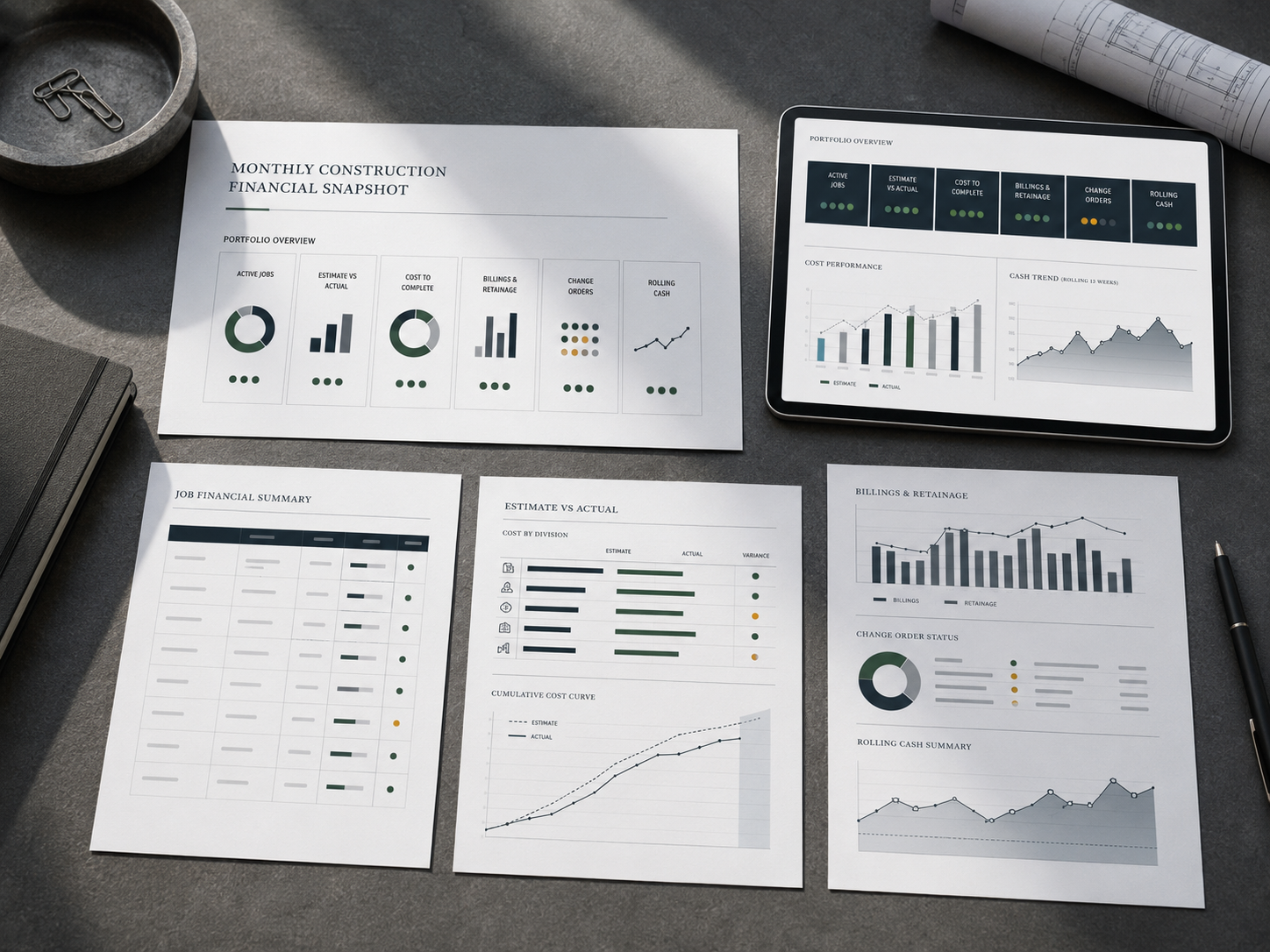
Active jobs
Which projects need attention this month, and which are moving as expected?
Estimate vs. actual
Where are labor, materials, subs, equipment, or overhead moving away from the bid?
Cost to complete
What is left to spend, and how does the latest estimate change expected profit?
Billings & retainage
What has been earned, billed, collected, or held back—and what does that do to cash?
Change orders
Which changes are approved, pending, unbilled, or old enough to threaten margin and collections?
Cash & capacity
Can the business cover the next payroll, material buy, equipment need, and project start?
How getting started works
Get the slate clean. Then use it.
We start by understanding the books, the job systems, the cash pressure, and the decision that made this matter now.
01
Books & cash review
We review the close, job-cost setup, WIP, change orders, retainage, systems, and the immediate owner questions.
02
Secure onboarding
We collect access through secure systems, confirm responsibilities, and avoid using ordinary email for sensitive documents or credentials.
03
Clean up and close
We reconcile the books, clean the job and cost-code structure, resolve open items, and build the first useful management view.
04
Run the monthly rhythm
We close, review WIP and job issues, update cash where scoped, and explain the decisions the numbers support.
Scope and responsibility
What we handle—and where we draw the line.
Good work starts with a clear lane. You should know what we own, what we support, and what belongs with another professional.
What we handle
- Bookkeeping, reconciliations, AP/AR accounting, and the monthly close.
- Job, phase, and cost-code reporting where the data and scope allow.
- Management-prepared financial reports and job-profitability views.
- WIP schedule support, change-order tracking, retainage views, and cash forecasts where scoped.
- Tax-planning support and draft preparation where scoped.
- Organized reporting support for lender or surety conversations.
What we coordinate or refer
- Tax return signing, formal tax opinions, and IRS representation by a licensed CPA or Enrolled Agent.
- Audits, reviews, compilations, and other CPA assurance work.
- Legal questions about contracts, liens, licensing, prevailing wage, worker classification, or disputes.
- Payroll-provider duties, insurance underwriting, or surety approval and bonding-capacity decisions.
- Specialized engineering, valuation, or investment advice.
Plain-English boundary: Slate and Summit is not a CPA firm. Our reports are management-prepared. We do not perform audits, reviews, or compilations, issue CPA opinions, or represent clients before the IRS. Licensed CPA or EA partners handle work that legally requires their credential.
Frequently asked questions
Questions contractors and remodelers ask.
Direct answers first. Details where they matter.
Can you help us know which jobs are profitable?
Yes. We can help organize job costing, cost codes, estimates, actual costs, WIP schedules, change orders, and cash timing so the owner can see profit earlier. The usefulness of the report depends on current source data and disciplined updates from the field and project team.
What is WIP?
WIP means Work in Progress. It is a schedule that shows where active jobs stand, including contract value, costs to date, billings, estimated costs, and earned revenue. A useful WIP schedule connects the latest job estimate with the accounting records.
Why does profit not match cash?
Construction cash can lag because of retainage, billing timing, slow collections, upfront materials, payroll, and change orders. Profit and cash are related, but they are not the same thing. A cash forecast shows when money is expected to arrive and when the business must pay it out.
Can you track change orders and retainage?
Yes, where the source data and scope allow. We can organize approved, pending, billed, and unbilled change orders, and show retainage by job or customer. The project team still owns timely field updates, approvals, and contract documentation.
Can you help with lender or bonding reports?
Yes. We can prepare and organize management reports, WIP schedules, cash information, and supporting detail for lender or surety conversations. The lender or surety sets its own requirements and makes the credit, underwriting, and bonding decisions.
Do you support percentage-of-completion accounting?
We can support the job-cost, estimate, billing, and WIP information used when revenue is recognized over time. In plain English, that method recognizes revenue as the work progresses instead of waiting until the job is finished. The correct accounting and tax method depends on your contracts and facts, so we coordinate with the appropriate licensed professional where an opinion or tax position is required.
Can you work with our construction software?
Often, yes. During scoping, we confirm what your project-management, estimating, billing, payroll, and accounting systems can provide; what can be integrated; and what needs cleanup. We do not force a software change when the current stack can produce reliable data.
Are you a CPA firm?
No. Slate and Summit is not a CPA firm. We provide bookkeeping, management reporting, tax-planning support, draft preparation where scoped, and CFO help. Licensed CPA or Enrolled Agent partners handle tax return signing, IRS representation, audits, reviews, compilations, and other work that requires their credential.
Next step
Know what the next job can afford.
Bring the current books, job-cost setup, WIP, and cash questions. We will identify what is usable, what needs cleanup, and what a practical monthly rhythm should include.
Slate and Summit is not a CPA firm. Our reports are management-prepared. We do not perform audits, reviews, or compilations, issue CPA opinions, or represent clients before the IRS. Licensed CPA or EA partners handle work that legally requires their credential.